
Nothing is wasted
Knowing what to keep, what to fix, and what to let go

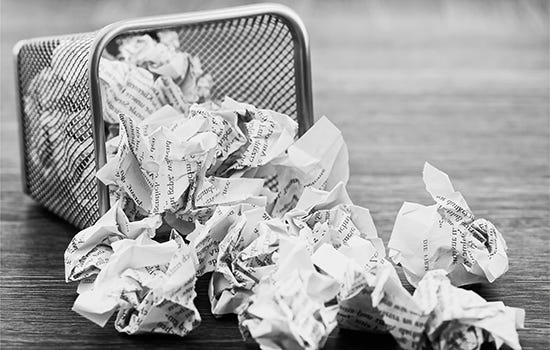
We have all been there before. You are working on a novel, a short story, a poem, and there is a line, a paragraph, a scene or, dare I say it, an entire book that isn’t working and you know it. You try and convince yourself that maybe you’re being overly critical or need to go for a walk or have a snack but every time you come back to the page, you know deep down that something isn’t right.
This point is one of the hardest parts of the process; it’s also the decision point which, after practice, many writers get better at navigating. Because knowing when you need to keep something and just do the bloody hard work to make it better, and when you need to let something go and move on is an art form all unto itself.
The trouble is that creative writing advice often arrives in absolutes. Never give up. Push through. Finish everything. Trust the process. But anyone who has written seriously for long enough knows there’s another reality: not every idea deserves years of your life. And not every scene you’ve spent weeks crafting deserved to stay.
Good writing often becomes difficult precisely because you’ve reached the interesting part. You’ve moved beyond the easy, obvious version and arrived at material that asks more of you. This can often happen in the messy middle. You might find yourself circling the same scene for days. You might feel uncertain about where a character is heading. You might repeatedly avoid opening the document. That doesn’t automatically mean the work isn’t working.
Nobody tells this to people who are beginners... all of us who do creative work get into it because we have good taste... It’s only by going through a volume of work that you will close that gap.
Ira Glass
The trick is (probably like much in life) to ask yourself the difficult question, ‘Am I resisting this because it’s difficult, or is it simply not working?’
You are the only person who will know how your aversion to hard work turns up, and whether you’ve just been avoiding the critical thinking, or whether you’ve honestly tried a few times and know deep down something isn’t going to work.
Sounds a bit like a lose/lose situation doesn’t it (inset laughing emoji). Writing, and probably anything that requires a lot of hard work, can be full of that feeling. But the pay off, also, makes it all worth while.
I have written other articles about the drafting process, and also on tricks and tools you can use to edit and to do the hard work.
But in this article I want to talk about the other side of things, the letting go of things.
I could wax lyrical and utilise a lot of the creative writing advice and theory out there about killing you darlings and when, why and how to do this. But I’m not going to do that. Instead I am going to share a piece of advice I have only really recently begun to understand both practically and emotionally (a piece of advice I wish I had known earlier) and that is…nothing is wasted.
I can’t stress this enough. Nothing is wasted.
You might put the novel draft in a drawer, you might delete a scene or a darling character, but none of it is wasted.
And not simply because you might steal a sentence from it later or resurrect a side character in another story. Yes, that happens. Writers are magpies and thieves and collectors of shiny things. But that isn’t really what I mean.
I mean that writing is practice.
We often talk about writers as though brilliance arrives fully formed. As though some people are simply struck by lightning and emerge with masterpieces while the rest of us stare blankly at our laptops wondering what on earth we’re doing.
Quantity produces quality. If you only write a few things, you're doomed.
Ray Bradbury
But we don’t think about athletes this way.
No one watches a tennis player at Wimbledon and assumes they simply woke up one morning able to do that. We understand instinctively that behind every moment of grace are thousands and thousands of unseen hours: drills, repetitions, training sessions, failures, strengthening muscles no one ever sees.
Musicians spend years practicing scales. Dancers rehearse movements until their bodies remember them without thinking. Athletes repeat the same motions over and over until skill becomes muscle memory.
Writing is no different. We just hide our training better. Because nobody sees the scene you deleted. You don’t have a coach or a parent watching or a teacher giving you feedback.
Nobody sees the abandoned chapter or the short story that collapsed halfway through or the novel draft sitting untouched in a folder on your desktop called Draft_Final_ActuallyFinal_V2.
But those things are your training. That scene you cut taught you pacing. That character who never worked taught you something about motivation. That chapter you rewrote six times taught you rhythm. That manuscript you abandoned after eighty thousand words taught you endurance. You wrote it, and in writing it you built something. Not just on the page, but in yourself.
I think we often imagine writing as producing words, when really we are also building muscles. We are developing instincts. We are teaching ourselves to recognise when something sings and when something falls flat. We are learning to hear our own voice.
And like any kind of training, progress is often invisible while it’s happening. You don’t notice yourself becoming stronger day to day. Then one afternoon you sit down and write a scene that suddenly works in a way you couldn’t have managed two years ago. But that’s because of the practice, and because of the words you threw away.
So… if you are standing at that difficult point now (staring at a scene, a chapter, a manuscript and wondering whether letting go means failure) maybe remember this:
Athletes don’t mourn every practice session because it wasn’t match or a meet or a grand final. Musicians don’t grieve every scale they played because it wasn’t a finished recorded song.
The work was never wasted because the work was the training.
And perhaps that is one of the most comforting things about being a writer: every sentence, even the ones no one will ever read, is still making you into someone capable of writing the next one. And, maybe, a better one.
Megan x